

n8n vs Make vs Zapier
The honest comparison for businesses that are tired of paying per task.
Three Ways to Automate the Boring Stuff
Every growing business hits the same wall. You are copying leads from a form into a spreadsheet, sending the same follow-up for the tenth time this week, and wondering why a computer is not doing this for you. Automation platforms exist to fix exactly that, and three names come up in almost every conversation: Zapier, Make, and n8n.
We build automations for clients across Surrey and the Lower Mainland, and we have run serious workflows on all three platforms. This is the comparison we wish someone had handed us at the start. Fair warning: we have a favorite, and we will tell you exactly why.
What Each Platform Actually Is
Zapier is the household name, with more than 9,000 connected apps and a learning curve measured in minutes. Pick a trigger, add actions, and your Zap runs. Simple work, done simply.
Make, formerly Integromat, takes a different approach: a visual canvas where scenarios branch, loop, and merge. It handles complex logic that Zapier struggles with, and it costs less.
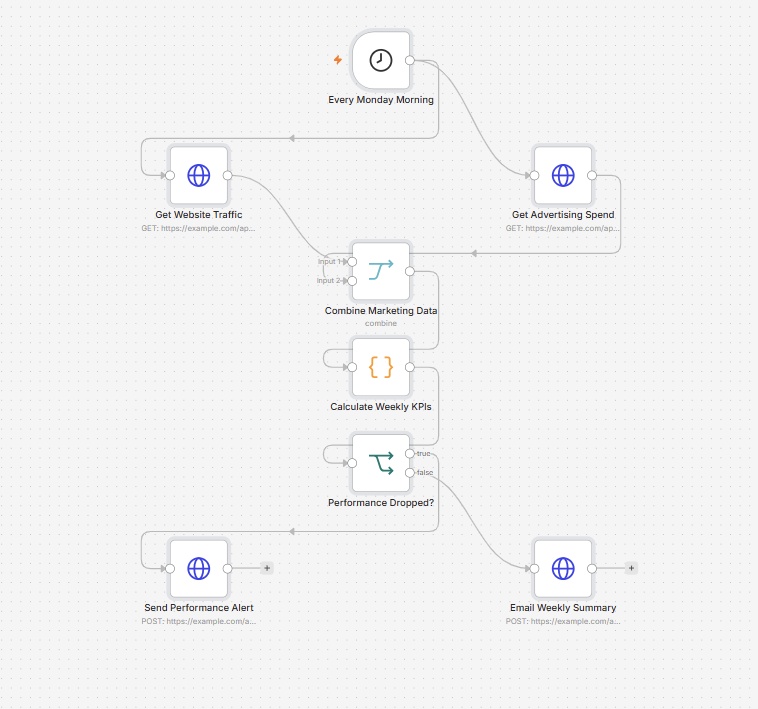
Then there is n8n, the open one. Run it in their cloud or install it on your own server. It is node-based like Make, comfortable with real code when you need it, and it has quietly become the tool of choice for teams building AI workflows. Investors noticed: n8n raised 180 million US dollars in a Series C round in October 2025 at a 2.5 billion dollar valuation, and by May 2026 SAP had taken a strategic stake that valued the company at 5.2 billion dollars, more than double in seven months.
The Pricing Models Tell You Everything
The three platforms count usage in completely different ways, and this is where budgets are won or lost.
Zapier meters tasks. Almost every action step consumes one, so a ten step Zap can burn nine tasks on every single run. The free plan covers 100 tasks a month, paid plans start around 20 US dollars for 750, and overages bill at 1.25 times your plan rate.
Make moved from operations to credits in 2025, which tells you something worth remembering: billing models change underneath you. One standard module operation costs one credit, AI features burn several, and since late 2025 extra credits cost 25 percent above the in-plan rate. Paid plans start at 9 US dollars a month for 10,000 credits on annual billing, which is genuinely good value.
n8n counts executions instead. One run of your workflow is one execution, whether it has three steps or thirty. Cloud plans start at 20 euros a month for 2,500 executions, and the self-hosted Community Edition is free, with unlimited workflows, unlimited executions, and unlimited users.
Numbers make this concrete. Take a ten step workflow that runs 1,000 times a month. On Zapier that is roughly 9,000 tasks, which pushes you into plans that typically run well past 70 US dollars a month. On Make it is about 10,000 credits, roughly 9 dollars. On n8n Cloud it is 1,000 executions, covered by the 20 euro Starter plan. On self-hosted n8n it is the cost of the small server it runs on, somewhere between 5 and 25 dollars a month, no matter how often it runs.
One workflow. One server. One flat cost.
That is the self-hosted difference.
Where the Costs Diverge
Task-based billing punishes success. The more your business automates, the more every automation costs, and teams end up designing workflows around their invoice instead of their process. We have watched businesses trim useful steps out of Zaps just to stay under a plan limit.
Flip the model and the incentives flip with it. Once n8n is running on your own server, a workflow that fires 50 times a month and one that fires 50,000 times cost exactly the same: nothing extra. You stop rationing your own efficiency.
There is a quieter risk with rented meters too: they get redesigned. Make replaced its operations model with credits in 2025, then raised the price of overflow credits within months. Zapier bills overages at a premium as well. None of that is scandalous, but every repricing lands on your side of the table. A five dollar server has never once changed its billing unit.
The AI Agent Wrinkle Nobody Prices In
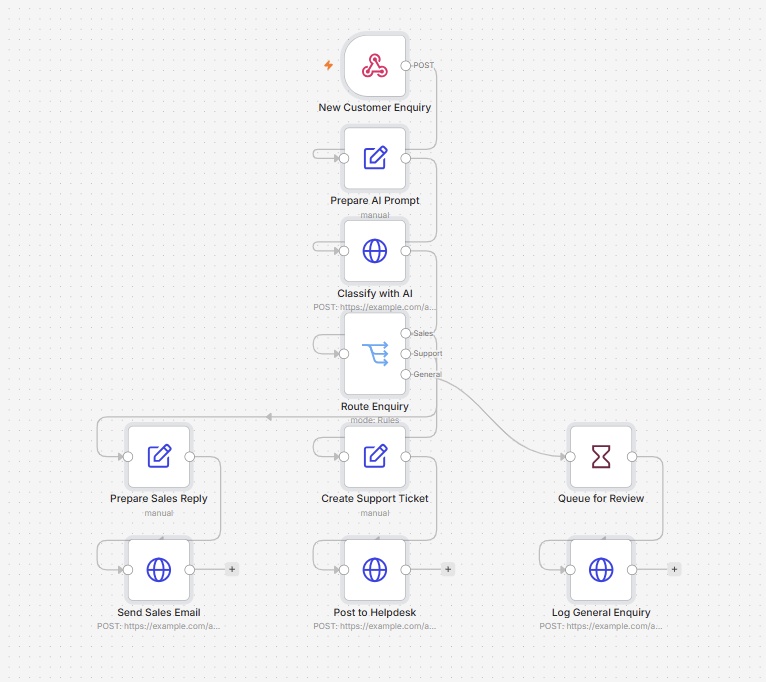
Our contrarian take is that the platform wars of the last decade were about integrations, and the next five years are about AI agents. Agents break per-step billing. An agent does not run a tidy five step sequence: it loops, retries, calls tools, checks its own work, and sometimes takes thirty steps to finish a job you could not have scripted in advance.
Each vendor has answered differently. Zapier sells Agents on a separate plan billed in activities, free to start and about 400 US dollars a year for 1,500 activities a month after that. Make prices AI modules in multiples of credits, and token-hungry models burn through them quickly. n8n treats an entire agent run, however winding, as a single execution, and on your own server even that meter disappears.
If you plan to experiment with AI in your operations, and in 2026 you should, our advice is to pick a platform where a curious agent cannot surprise you on an invoice. That is not a knock on Zapier or Make. It is an observation about incentive design: metered platforms profit from your complexity, while a server you own does not care how hard your automations think.
The Case for Self-Hosting
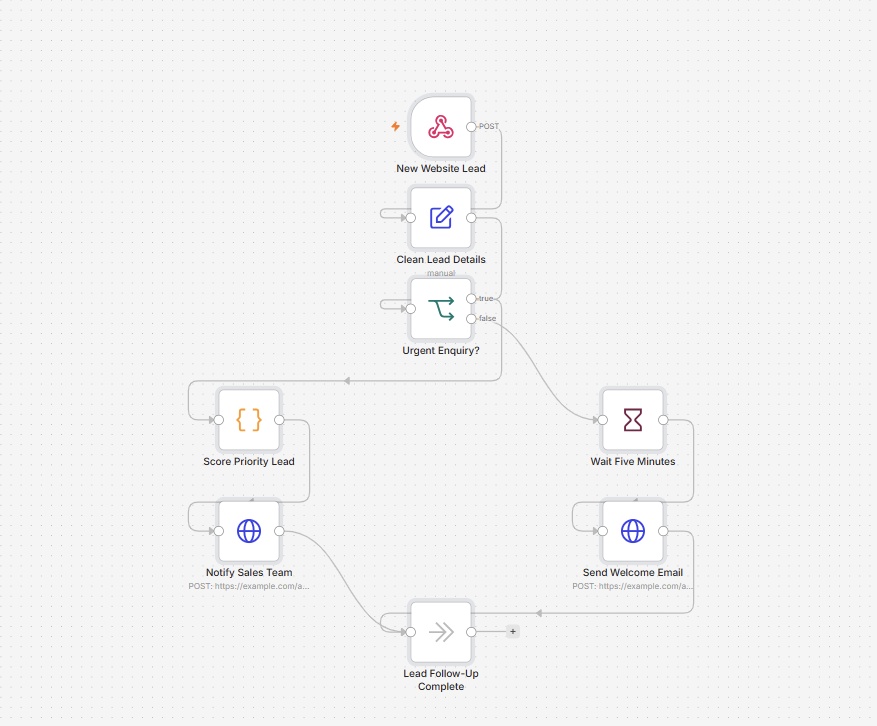
Self-hosted n8n runs on hardware you control. A small VPS from about 5 US dollars a month will comfortably handle most small business workloads, and Docker makes the install straightforward for anyone who has managed a server before.
Want to spin one up on the cheap? Grab a budget server from RackNerd, where small VPS deals often work out to a dollar or two a month, and point a spare domain’s A record at the server’s IP. Then hand an AI coding agent like Claude Code or GPT Codex SSH access to that fresh server and tell it to install n8n on the domain. The agent handles Docker, HTTPS, and the reverse proxy, and you will be looking at your own n8n login screen in about twenty minutes. Just keep that server dedicated to n8n and nothing else.
Your data is the bigger win. Customer records, form submissions, and email contents flow through your own machine instead of a third party cloud in another country. For Canadian businesses that simplifies PIPEDA accountability, and if you serve government or health sector clients, data residency is often not optional anyway.
One honest caveat belongs here: a server is a responsibility. Updates, backups, and security are on you, and n8n themselves recommend their cloud if you have never managed one. Fair enough. It is also exactly the kind of setup an agency can do once, properly, so you get the flat costs without the learning curve.
Where Zapier or Make Still Win
If your team is non-technical and your needs are light, Zapier remains the fastest path from idea to running automation, and nobody matches its 9,000 app catalogue.
Make earns its place too. For powerful visual logic in the cloud at a low entry price, its 9 dollar Core plan is genuinely hard to argue with.
n8n, for its part, is not effortless. The node editor thinks like a developer, its cloud bills in euros, and its licence stops you from reselling n8n itself as a hosted product. For running your own business automations, none of that gets in the way.
Our Recommendation
For most growing businesses past their first few simple automations, self-hosted n8n is the strongest option available in 2026. Flat costs, full ownership, real AI workflow tools, and no meter running in the background.
We set up self-hosted n8n for businesses across Surrey and the Lower Mainland: server, security, backups, and your first workflows, done right. If you would rather own your automation stack than rent it, talk to us.
Prices and platform details checked July 2026. Oi Marketing is not affiliated with n8n, Make, or Zapier.